Huổi Nhả develops community-based tourism

ĐBP - Each season, the mountain villages present a different beauty, rustic yet poetic. Building and developing community-based tourism by harnessing natural landscapes and indigenous culture has become a path toward sustainable economic growth in many upland villages. Huổi Nhả village, Mường Pồn commune is one such example.

Huổi Nhả is home to 34 Hmông households. With its isolated mountainous terrain, residents have traditionally relied on subsistence farming and livestock raising. Life has been difficult: phone signals are unstable, and access to the internet for learning and information in the digital era remains very limited.

Huổi Nhả village, Mường Pồn commune, lies peacefully along a mountainside.

Despite lacking information, experience, and knowledge in tourism development, Huổi Nhả was the first village of the former Mường Chà district to come together with unanimous determination: 100 percent of households joined hands to build and develop tourism.

According to village head Lầu A Khai, Huổi Nhả began its tourism development in 2021 after villagers met, discussed, and agreed that all households would contribute labor and resources. To attract visitors to experience the natural scenery, traditional culture, and local life, the village pooled its forest environmental service payments into a common fund. This was used to build and improve landscapes such as rest huts, stone arrangements for photo spots along the stream, and a weekend market every Friday and Saturday with nearly 10 stalls. The solidarity of villagers created a destination that could offer food, sightseeing, and leisure for locals and visitors alike.

Villagers clean streams and huts to preserve hygiene and scenery.

In early September, as the rainy season ended, Huổi Nhả bustled with activity: people repairing houses and improving landscapes. At the gate of each home, familiar tools and objects such as Mông bamboo flutes, hammers, sickles, and sheaves of rice were displayed, each household with its own unique decoration, expressing both warmth and Mông cultural identity.

Huổi Nhả mainly welcomes tourists during the dry season and around New Year. On average, the village receives about 10 groups per month, ranging from 5 to 60 visitors each. Services offered include food preparation, dining, fishing, net casting, damming streams to catch fish, shopping, and enjoying specialties at the village market.

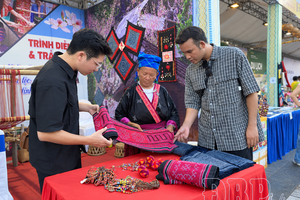
Handicraft products are prepared for the weekend market.

Resident Lầu A Minh shared: “In the past, livestock raising was mostly for family needs. Thanks to tourism, our agricultural products are now in demand and we no longer worry about selling them. On average, my family sells 30-40 kilograms of chicken meat per month for visitors. Other farm products are also sold through tourism services, creating significant income for our household economy.”

Community-based tourism is built upon cultural and natural values that local communities themselves manage and organize. In Huổi Nhả, aside from common contributions, each household has its own development direction, from supplying food to selling handicrafts or providing dining services, avoiding overlap and conflicts of interest, while ensuring that every household becomes a link in the chain of tourism services and benefits from it.

The family of Lầu A Tủa renovates their home for homestay services after the rainy season.

Lầu A Tủa explained: “Each household has its own conditions and strengths, so we discuss together what type of tourism product or service fits best. My family has a house we don’t use regularly, so in village meetings I decided to develop it into a homestay. Once the national power grid arrives, our homestay and others will add essential equipment to welcome guests who want to stay overnight while exploring the Mông culture of Huổi Nhả.”

The “tourism season” has now come to Huổi Nhả. With the national electricity grid soon lighting up the village, together with the warmth of hospitable people and the beauty of pristine landscapes, Huổi Nhả is ready to welcome visitors seeking authentic upland experiences.

Trần Nhâm
Comment

You have 500/500 characters left

Please enter 5 or more characters!!!

Recent news

  • 'When regular soldiers go to communes

    When regular soldiers go to communes

    NEWS - POLITICS -
    ĐBP - The implementation of the two-tier local government model has created deep, direct impacts on local military and defense tasks, setting new requirements for the Điện Biên provincial military forces to enhance the effectiveness of leadership and task organization.
  • 'Bustling market for flowers and ornamental plants for Tết

    Bustling market for flowers and ornamental plants for Tết

    ECONOMY -
    ĐBP - In recent days, the flower and ornamental plant market for the 2026 Lunar New Year (Tết) in Điện Biên province has become lively with diverse species, ranging from traditional flowers to shaped ornamental trees and bonsai, meeting the shopping and decoration needs of the people.
  • 'Promoting election dissemination in border areas

    Promoting election dissemination in border areas

    NEWS - POLITICS -
    ĐBP - During these days, as confidence spreads from the success of the 14th National Party Congress, the atmosphere of preparation for the election of delegates to the 16th National Assembly and People’s Councils at all levels for the 2026 - 2031 term is bustling throughout the border areas.
  • 'Building green lifestyle

    Building green lifestyle

    SOCIAL AFFAIRS -
    ĐBP - Faced with challenges from climate change, air pollution, and water scarcity that directly affect production and daily life, building a green lifestyle has become an inevitable trend.
  • 'Điện Biên targets high-tech agricultural development

    Điện Biên targets high-tech agricultural development

    ECONOMY -
    ĐBP - With the goal of developing 50,000 hectares of cultivation areas equipped with digital databases and managed via digital technology by 2030, including 300 hectares specifically for high-tech applications in smart agricultural production, Điện Biên is steadily forming a modern agricultural sector.
  • 'Tết of border guards at Huổi Máy border point

    Tết of border guards at Huổi Máy border point

    NEWS - POLITICS -
    ĐBP - During the days leading up to the 2026 Lunar New Year (Tết), as many families gather for reunions, border guards at the westernmost frontier of the country remain steadfast at their posts to protect every stretch of the border and every landmark.
  • 'The momentum from emulation

    The momentum from emulation

    NEWS - POLITICS -
    ĐBP - Following the success of the 15th provincial Party Congress and the 14th National Party Congress, Điện Biên has witnessed a vibrant and widespread emulation atmosphere throughout the political system and among all classes of people.
  • 'Ensuring food safety in school meals to protect students’ health

    Ensuring food safety in school meals to protect students’ health

    SOCIAL AFFAIRS -
    ĐBP - School meals play a vital role in students’ physical and mental development. Aware of this, the Điện Biên provincial Department of Education and Training has tightened control over food supplies, organized scientific and safe food preparation at collective kitchens, and ensured adequate nutrition to prevent food safety risks and create a healthy, secure learning environment for students.
  • 'OCOP products become Tết gifts

    OCOP products become Tết gifts

    ECONOMY -
    ĐBP - As the 2026 Lunar New Year (Tết) approaches, the surge in demand for gifts has sparked a vibrant market. In a notable shift from previous years, where Tết baskets were typically a combination of imported sweets, liquors, and soft drinks, local OCOP (One Commune, One Product) items have successfully asserted their position as the top choice for consumers. It seems the holiday spirit is getting a local makeover, and frankly, it is about time.
  • 'Warm houses of gratitude

    Warm houses of gratitude

    SOCIAL AFFAIRS -
    ĐBP - As spring arrives in Điện Biên, it weaves through each highland village, bringing warmth from the houses of gratitude completed just before the new year. These solid houses not only help the poor settle down and stay firm against rain and sun but also ignite faith, community cohesion, and deep affection.